

New to the topic? Start with our beginner’s guide to sourcing intelligence for industrial buyers.
The first page trap
Type “french brushless motor manufacturer” into Google and you will get exactly what you would expect: a wall of B2B directories (Europages, DirectIndustry, Kompass), a handful of “Top 10” listicles, and only a few relevant companies. That is not because there is nothing else out there. It is because search engines reward whoever publishes the most about manufacturing, not whoever is best positioned to actually make your part.
The companies you are actually looking for: the motor designer in Provence who also holds defense contracts, the family-owned business near Toulouse that has been machining to aerospace tolerances for forty years. These companies have been building precision components for decades without ever needing a marketing budget to thrive, because their reputation travels through qualified engineers, not search rankings.
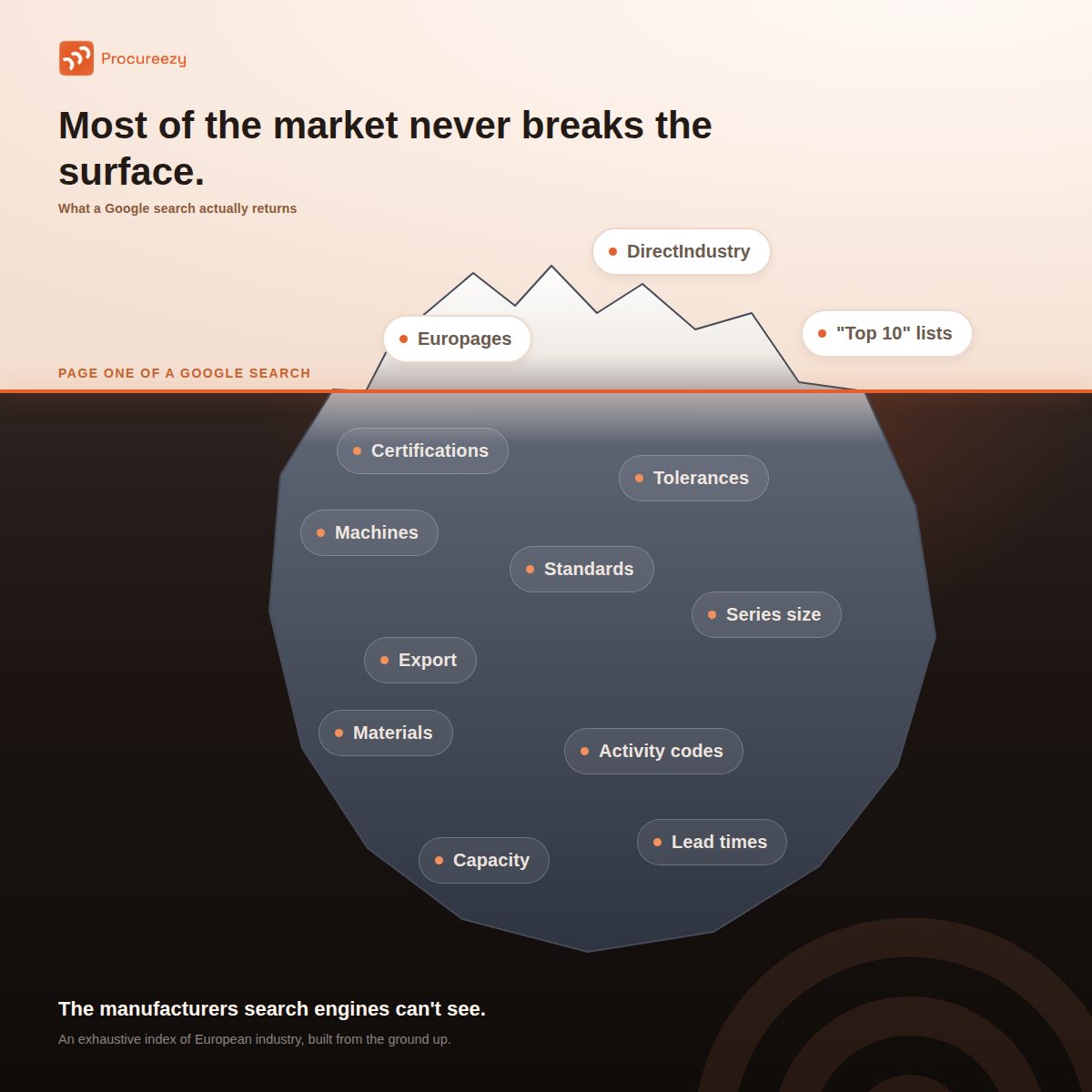
That is the part of the French industrial base a generic Google search simply does not surface. The cost is a supply chain that stretches to Shenzhen when it could have stopped at Saint-Étienne. Lead times are long, and global disruptions such as a pandemic or a closed strait put your production line in jeopardy.
Even AI search hits the same wall
The reason is structural.
A general-purpose AI assistant answers from two sources. The first is its internal knowledge, learned in training from text scraped at scale across the web, which over-represents exactly the well-linked, content-rich sites that already dominate search. The second is live web search, which queries the same indexes (Google, Bing, Brave) and inherits the same rankings.
Its real power is fusion: combining a broad understanding of the market with the results of several queries at once. But what it returns is the knowledge accessible from the first pages of Google. In practice, it rarely goes past the first results of each query.
How we solve the problem
We’re building an index of every industrial manufacturer in Europe. Our goal is to cover every company that exists, not only those that chose to sign up.
Exhaustiveness is the point. When you search for a French brushless motor manufacturer, you should get all of them, and be able to trust that boundary. Not a ranked selection of whoever invested in visibility. The set. A directory can only tell you about the companies it knows about; it can never tell you what it is missing.
A directory can only tell you about the companies it knows about. It can never tell you what it is missing.
Narrow scope buys precision, too. Because we’re indexing one continent’s industry rather than every web page on Earth, we can model what a manufacturer actually does: machines, materials, tolerances, certifications, series sizes. A directory tells you what a company sells. We want to tell you what it is capable of making, which is the question you’re really asking when the part you need doesn’t exist yet.
France first, then the rest of Europe, country by country. We’ll bring you along: as each country comes online, we’ll profile the manufacturers whose capability far outstrips their visibility.
Europe needs a strong industrial backbone. The first step is knowing what is already produced on this side of the border.