A modern approach to finding, evaluating, and comparing space-grade components, trusted suppliers, and qualified manufacturers for missions where reliability matters most.
Sourcing components for space missions is one of the most demanding procurement challenges in any industry. Whether building CubeSats, payload systems, propulsion modules, or onboard electronics, teams must identify suppliers that meet strict reliability, qualification, and performance requirements.Traditional sourcing tools make this difficult. Supplier information is scattered, datasheets are inconsistent, and comparing options takes weeks of manual work. Modern missions need a faster, clearer way to discover and evaluate space-ready components.
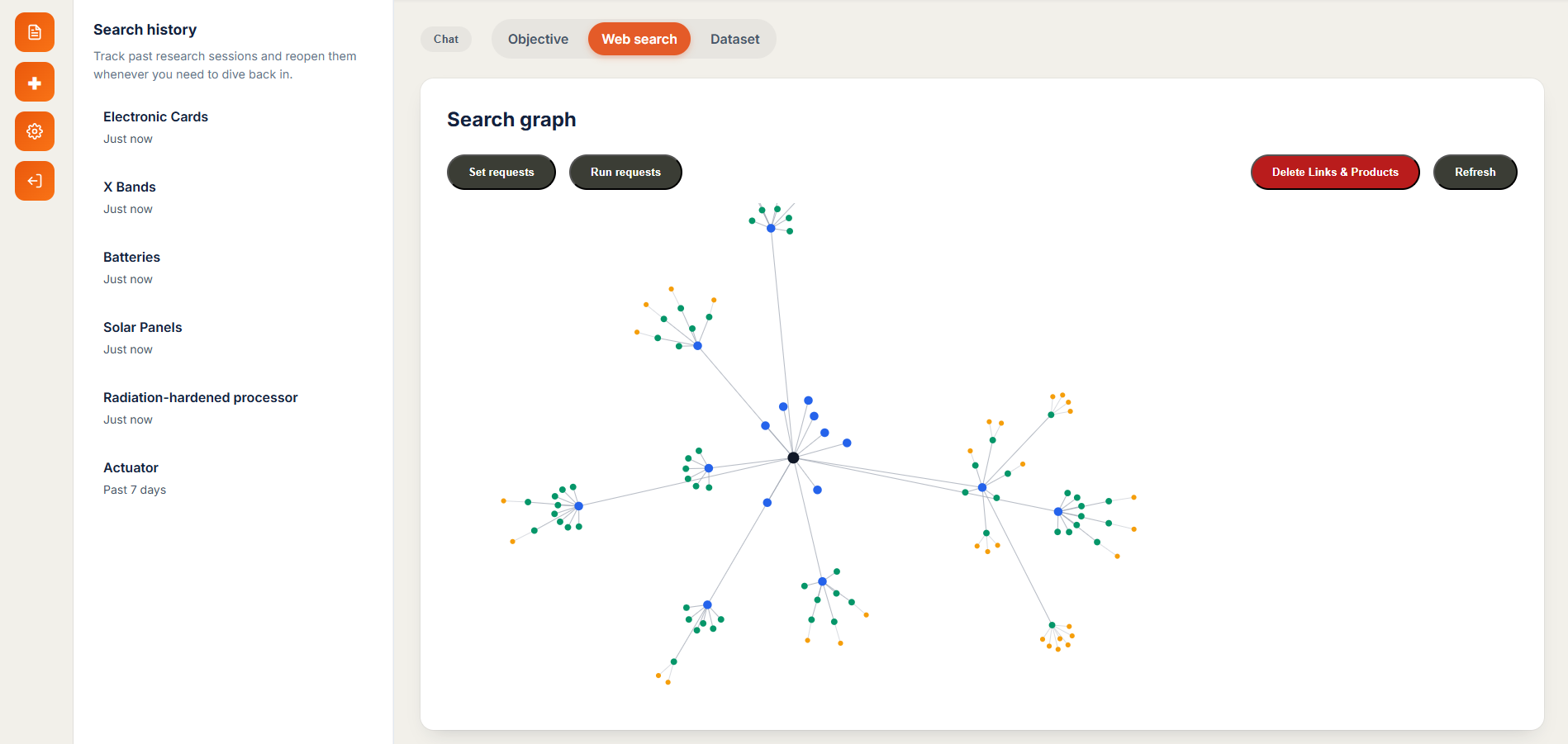

Space-grade components must withstand extreme conditions, long mission durations, and high failure consequences. This creates sourcing challenges unmatched in other industries.Common issues include:
1. Limited Availability of Space-Qualified
manufacturers are spread across niche markets, with inconsistent visibility and incomplete public documentation.
2. Fragmented Technical Information
Datasheets vary widely in format, making it difficult to compare specifications for radiation tolerance, thermal stability, mass, power consumption, and lifetime performance.
3. High Certification and Reliability Requirements
Teams must verify qualification levels, flight heritage, TRL (Technology Readiness Level), and compliance standards.
4. Long Sourcing Cycles and Supplier Bottlenecks
Manual discovery and vendor outreach slow down mission timelines, especially when evaluating alternatives or replacements.
5. Difficulty Benchmarking Similar Components
Even when multiple options exist, comparing them requires pulling data from dozens of websites, PDFs, and legacy catalogs.
These challenges make speed and accuracy critical during early sourcing phases.
To support fast-moving satellite and space-system development, sourcing tools must provide:
1. Centralized visibility into space-grade components
Including key parameters such as radiation tolerance, operating temperature, form factor, mass, and power requirements.
2. Faster, structured supplier discovery
Teams need to identify qualified suppliers without browsing hundreds of separate websites.
3. Clear comparison between component alternatives
Side-by-side views of specifications, capabilities, and certifications shorten evaluation time and reduce mission risk.
Radiation-hardened components
CubeSat components and subsystems
Space-grade sensors and actuators
Onboard computing and avionics
Power systems and EPS modules
RF communication hardware
Thermal control components
Propulsion components and valves
Structural and mechanical parts for spacecraft
Procureezy helps space teams shorten sourcing cycles and improve supplier visibility by turning any component request into a structured benchmark.
With AI-assisted supplier discovery, specification extraction, and unified comparison tables, teams can:
Discover space-grade suppliers faster
Compare components based on mission-critical specifications
Identify alternatives quickly when part availability changes
Reduce manual research across fragmented sources
Improve decision-making during early design and development phases
Instead of navigating dozens of sites, teams get a clear view of the component landscape in minutes.